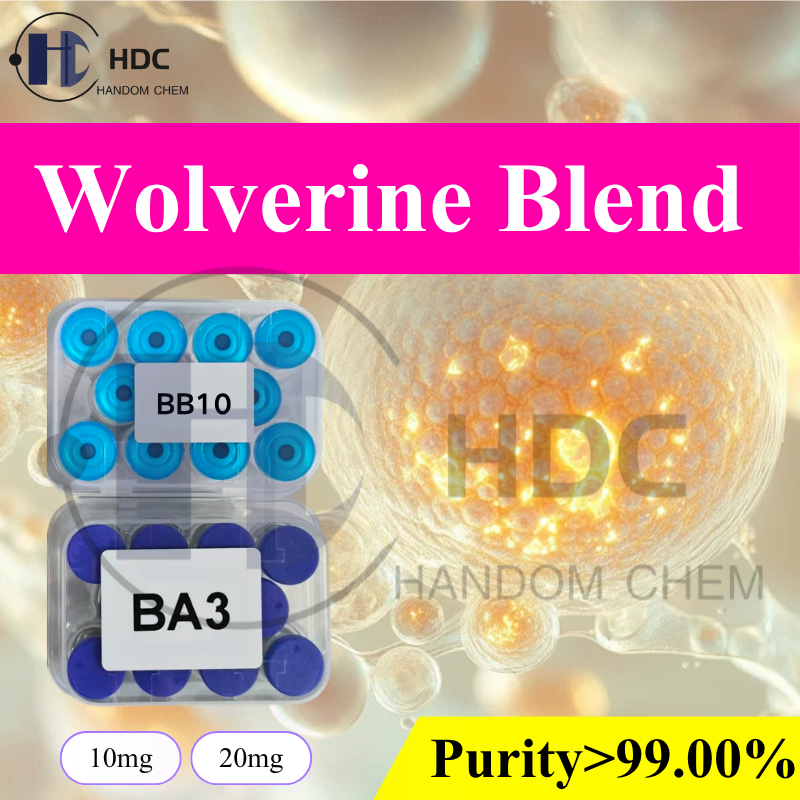
Wolverine Blend, also called Wolverine Stack, is an informal name used in the research-peptide market for a combination commonly containing BC and TB-500. It is not a single, chemi
♔ Sequence:
·BC: Gly-Glu-Pro-Pro-Pro-Gly-Lys-Pro-Ala-Asp-Asp-Ala-Gly-Leu-Val (GEPPPGKPADDAGLV).
TB-500: The sequence depends on the specific substance used. Some products labeled TB-500 refer to the synthetic heptapeptide Ac-Lys-Leu-Lys-Lys-Thr-Glu-Thr-Gln (Ac-LKKTETQ), while other products may use different 4-related materials. The exact identity should be verified from the product's analytical documentation.
·
♔ Mechanism of Action:
Wolverine Blend is proposed to influence tissue-repair processes through the distinct biological activities attributed to its individual components:
BC: Preclinical studies have investigated its potential effects on angiogenesis, signaling, and tissue repair. Findings from animal and laboratory studies do not establish the same effects in humans.
TB-500 / -4-related peptides: 4 is involved in actin regulation, cell migration, and wound-healing processes. However, findings involving full-length -4 can not automatically be applied to every product marketed as TB-500.
Combined Effects: The proposed rationale is that the two components may influence different aspects of tissue repair. However, a synergistic effect of the marketed combination has not been established in controlled human clinical trials.
♔ Indications and Efficacy:
1) Musculoskeletal Tissue Repair:
BC has been investigated in animal models involving tendons, ligaments, and muscles. These findings are preliminary and do not establish clinical efficacy for human injuries.
2) Wound Healing and Cellular Repair:
TB500 has been studied for its potential role in cell migration, tissue regeneration, and wound healing. Evidence for these effects varies by formulation and experimental setting, and can not be assumed to validate the Wolverine Blend itself.
3) Inflammation and Recovery:
Laboratory and animal research has explored pathways associated with inflammation and tissue recovery. There is currently insufficient clinical evidence to conclude that Wolverine Blend reduces inflammation or accelerates recovery in humans.
4) Safety and Clinical Status:
Wolverine Blend is not an established, approved treatment for tissue injuries or other medical conditions. Its long-term safety, optimal formulation, interactions, and clinical efficacy remain uncertain. Claims of accelerated healing or superior recovery should therefore be regarded as unproven until supported by well-designed human clinical trials.